Exclusive: Interview with International Rugby Board chairman Bernard Lapasset
by Colin Spiro 21 October 2008
|
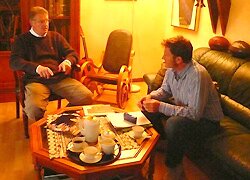
Holding Court: Bernard Lapasset
|
Part I: My Olympic dream
“I think the Olympics needs rugby. We have the possibility to extend the value of the Olympic movement in the world.”
Big crowds, big money, big television audiences and even bigger television revenues. The world economy may be experiencing ‘le credit crunch’ but these are boom times for rugby union as it seeks to establish itself as a truly global sport.
Rugby has seemingly never been in ruder health, but for one man that is not enough. There are a series of vast challenges that lay ahead, demanding his full-time attention and an almost missionary zeal as he seeks to spread the good word around the world.
His name is Bernard Lapasset, the current chairman of the International Rugby Board – presently in his second three-year term - and the man widely responsible for ensuring the last Rugby World Cup, hosted by his native France, was deemed such a success.
Not satisfied with having already laid a sufficient legacy for most normal men Lapasset is now steering the IRB through a maze of other ventures designed to cherish, nurture and develop his beloved sport – a role that requires him to jet-set around the world in search of new markets, new methods and new alliances.
Here, in an exclusive three-part interview with French Rugby Club, Lapasset talks about rugby’s continuing push to be included in the Olympic Games, why Russia and Brazil are getting him excited, the ongoing confusion over ELVs, the expanding north-south monetary divide and how the IRB is planning to integrate Argentina more fully into the top-level of international rugby. Oh, and why he also had three breakfasts a day when he was in Beijing recently.
First up, the Olympics, the world’s largest sporting event and a party which rugby – in a sevens format – is desperate to get an invite to. Lapasset is passionate about the global ‘rugby family’ and his enthusiasm for getting it a seat at sport’s highest table saw him travel to China this summer for some serious lobbying as he tried to convince IOC delegates about the value of adding it to future Games.
Gone are the days when rugby was merely considered an odd game played by the United Kingdom and a few of its former colonies, a fact emphatically reinforced by Argentina’s progress to third place in the last RWC and the current raft of Russians, Georgians and even Americans plying their trade throughout Europe’s professional ranks.
So how did it go in China?
“It was a privilege to be in Beijing because all the most important people in sport were there,” said the just-turned 61-year-old. “It is important now that we have foreign contacts with the IOC members and it’s also important that everyone knows what we are doing now. I met about 74 IOC members personally in three weeks.
“Every morning we started at breakfast – in fact we had three breakfasts every morning – and then we went to three different sports every day. It was not hard because I like sport, but it was important that we saw other sports as well and it was very interesting.
“I think a lot of people know rugby very well now and all over the world it has a good image. They say it looks good on TV screens, the atmosphere in the stadia is good, they enjoy the games – a lot of people in the IOC told me that, and that is very important.”
Speaking in English – his third language after French and Spanish - it seems to me that rugby could not have a better spokesman than Lapasset championing its cause. He has a rare love for the game that easily transmits through his almost boyish enthusiasm. But good will alone won’t get rugby an Olympic invite, and he is fully aware of that. The competition for inclusion is fierce and as such he has been wise enough to develop contacts throughout the sporting world, with such luminaries as Uefa chief Michel Platini, and current and former IOC presidents Jacques Rogge and Juan Antonio Samaranch respectively.
‘I think a lot of people say rugby is part of the sports family now, but the most important thing is to receive a good vote to be included in the Games,” he admitted.
“To recognise rugby is one thing, but to be in the program… that is another thing,” said the IRB’s longest-serving official.
“We have three important votes in 2009: (1) to elect the chairman of the IOC; (2) to chose the venue for the 2016 Olympics and (3) to finalise the program for the Olympics. Those are three key issues for us and we have one year to complete our presentations before those three big meetings.”
So, if all goes well rugby sevens could get the nod to become a fully-fledged Olympic sport – there are no more demonstration sports in the Games – by October 2009, with a view for inclusion in 2016, although there is one other alternative entry route.
|

Impassioned: Lapasset making his point
|
“The host city does have the possibility of including a cultural event in the Olympics, and the cultural event could be rugby. Why not? London is the host in 2012 and rugby is very important in Great Britain,” he said more optimistically than with real conviction.
That would be a back door entry of sorts and you get the impression that while Lapasset would welcome any sort of inclusion what he really yearns for is open-armed acceptance. But why is Olympic inclusion so important?
“It is a good promotion for rugby,” he admits is a disarmingly honest fashion. “It is important because we have 116 Union members in the IRB and in the Olympics you have 205. I think the Olympics needs rugby because we have new and smaller countries that could come in and compete for gold medals, like Fiji for example. They don’t feature highly in the Olympic movement but they are currently World Champions in sevens rugby.
“Therefore we have the possibility to extend the value of the Olympic movement in the world. That’s part of what we are doing and I think it’s a win-win situation. It’s a major part of my job now and it’s important that the focus on the Olympics should be a massive thing.”
With that he was off to show me his forthcoming diary, with trips to Mexico, Russia, Brazil and Africa underlining just how global the expanding game of rugby has become. It is already in the Commonwealth Games, could the Olympics really be next?
“The Rugby World Cup is the third biggest sporting event in the world, so why not?” he asks.
Why not indeed.
Bernard Lapasset Interview Part 2: My Hopes and Fears For The Game
Bernard Lapasset Interview Part 3: More Than Just a Game
|